The two creator roles Kenyan brands need to understand before choosing an influencer.
Introduction
A brand partners with a popular creator. The campaign earns strong views, lively comments and thousands of likes—but very few customers inquire, visit a store or make a purchase.
Another brand works with a smaller creator. The video is less glamorous, yet it answers the questions buyers actually have: What does the product cost? How does it work? Where can I find it? Is it worth the money? The comment section fills with practical questions, and the brand begins receiving direct messages.
Which creator performed better?
The honest answer is: it depends on the job each creator was hired to do. One may have been excellent at creating attention and credibility. The other may have been better at turning curiosity into consideration and action.
Core problem: Follower count tells you how many people may see a creator. It does not tell you what that creator can persuade them to do.
This is where the KOL and KOC framework becomes useful. The terms may sound unfamiliar in Kenya, but the behaviour behind them is already visible on TikTok, Instagram, Facebook and YouTube every day.
What is a KOL? The creator who makes people pay attention
KOL stands for Key Opinion Leader. A KOL is a recognised creator, specialist, public personality or industry voice whose opinion can influence how a broad audience understands a brand, product, service or subject.
The power of a KOL comes primarily from authority. That authority may come from professional expertise, a strong public reputation, cultural relevance, industry experience or a proven ability to shape conversations within a category.

What KOL content is designed to do
- Introduce a new brand, product or category to the market.
- Explain an important feature, innovation or industry development.
- Build credibility by associating the brand with a respected voice.
- Educate a large audience and influence public perception.
- Make people notice, trust or take a brand more seriously.
KOL takeaway: A KOL helps the audience answer: “Should I trust, notice or pay attention to this brand?”
A simple example
Imagine a recognised technology reviewer discussing a new smartphone. Their audience values the review because the creator understands devices, compares specifications and has built credibility over time. The review may not cause an immediate purchase, but it can shape the product’s reputation and move the phone onto the audience’s consideration list.
The KOL’s main job is not always to close the sale. It is often to open the door.
What is a KOC? The creator who makes the product feel real
KOC stands for Key Opinion Consumer. A KOC influences people through relatable consumer experience. Their content often feels less like a public endorsement and more like one customer explaining a product to another.
A KOC does not need to be the most famous person in the room. Their strength is making the product understandable, believable and relevant to an everyday buying decision.

What KOC content is designed to do
- Show how a product is used in real life.
- Explain features in simple, practical language.
- Share a personal experience, test or honest demonstration.
- Clarify price, value for money, availability and purchase options.
- Answer common buyer questions and reduce uncertainty.
- Direct viewers to a store, website, livestream, WhatsApp number or seller.
KOC takeaway: A KOC helps the audience answer: “Should I buy, try or inquire about this product?”
The same smartphone, a different job
A KOC reviewing the same phone may test the camera in daylight and indoors, show the battery after a normal working day, explain the available payment options and tell viewers where the device is sold. The content is not only informative—it removes the small doubts that prevent a consumer from acting.
The KOC’s role is to bring the product closer to the buyer’s reality.
The easiest way to remember the difference
KOLs and KOCs create different kinds of value. A KOL builds authority, creates awareness, shapes perception and makes people pay attention. A KOC builds relatability, reduces purchase doubt, demonstrates real use and makes people take action.
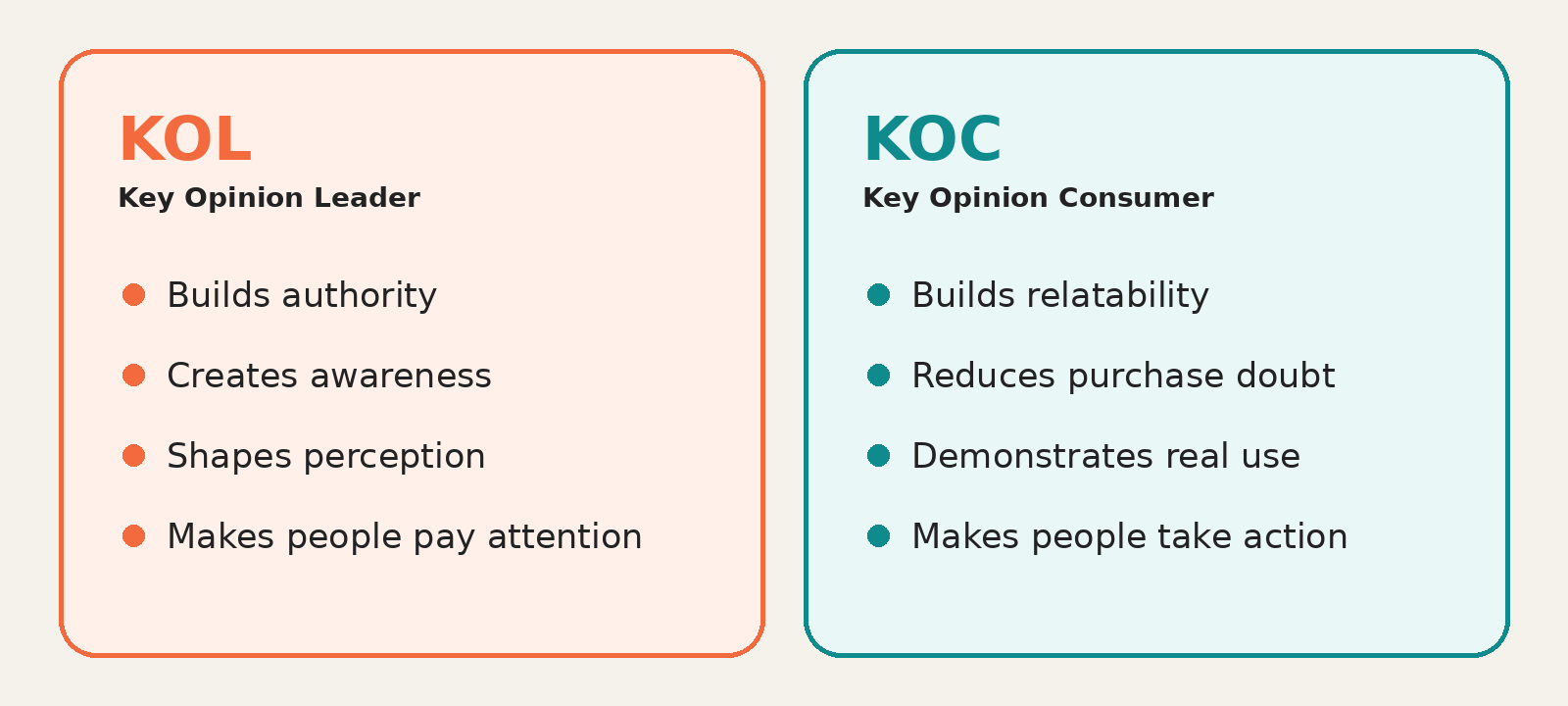
One product. Two creator scripts.
- The KOL version: “This phone introduces one of the strongest camera systems in its price category and raises the standard for mid-range devices.” The focus is significance, expertise and market perception.
- The KOC version: “I used this phone from morning to evening. Here is how the battery performed, how the camera looks indoors and where you can buy it in Nairobi.” The focus is real-life proof, practical details and action.
Neither role is automatically more valuable
A KOL is not automatically better than a KOC, and a KOC is not simply a smaller KOL. The two roles create different kinds of value. Their usefulness depends on the campaign objective.
A brand entering a new category may need a respected voice to explain why the product matters. A brand promoting a limited-time offer may need several relatable creators who can demonstrate the product, communicate the price and direct audiences to purchase.
One campaign may require authority. Another may require action. The strongest campaigns often require both.
Can one creator be both?
Yes. Some creators can perform both roles depending on the brief. A respected beauty creator may act as a KOL when discussing skincare knowledge or introducing a major product innovation. The same person may act as a KOC when showing a personal routine, reviewing the texture and price, and telling viewers where to buy.
These hybrid KOL/KOC creators can be extremely valuable—but only when the campaign clearly defines which role is required. Without that clarity, the creator may receive a confusing brief and later be measured against the wrong outcome.
Why Kenya should adapt the framework—not copy it blindly
KOL and KOC are international terms. The framework is useful, but classifications developed elsewhere should not be imported into Kenya as rigid rules. Audience size, language, culture, platform behaviour, purchasing power, creator economics and social-commerce habits differ from one market to another.
In Kenya, audiences often want more than a polished endorsement. They want to know the price, where the product is available, whether delivery is possible, how it performs in everyday conditions and whether the creator appears to have genuinely used it.
The Kenyan reality check
- Does this creator speak to the audience the brand actually needs?
- Can they explain the product in locally relevant language and situations?
- Do their followers trust their recommendations—or merely watch for entertainment?
- Can the creator move people from content to a store, DM, WhatsApp inquiry, website or livestream?
- Is the creator professional enough to deliver accurately and on time?
The value of the framework is not the label itself. It is the quality of the questions it forces a brand to ask.
How KOLs and KOCs work together
The strongest influencer campaigns do not force one creator to perform every function. They design a journey in which each creator type contributes at the stage where they are most effective.
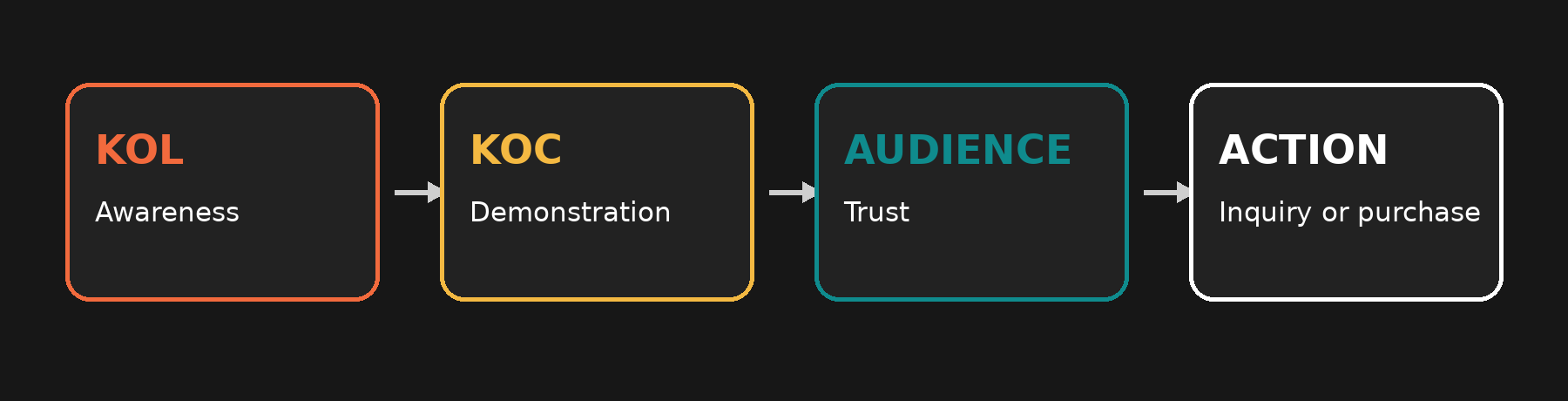
- A KOL introduces the product, frames the story and gives the campaign public credibility.
- The audience becomes aware of the brand and understands why it matters.
- KOCs demonstrate the product across different everyday situations and audience segments.
- Consumers compare benefits, price, availability and personal experiences.
- The audience gains enough confidence to inquire, click, visit, try or purchase.
What changes: KOL awareness → KOC demonstration → consumer trust → purchase action.
Measure creators according to the role they were hired to perform
One of the most common influencer-marketing mistakes is using the same success metric for every creator. A KOL campaign and a KOC campaign should not be judged in exactly the same way.
KOL: awareness and authority
Useful indicators include reach, relevant audience exposure, share of voice, quality of discussion, branded search interest and perception.
KOC: consideration and action
Useful indicators include saves, questions, link clicks, DMs, store requests, livestream traffic, affiliate orders and conversion.
Hybrid: awareness plus action
Use a balanced mix of reach, credibility signals, product questions, traffic and attributable response.
The five questions every brand should ask
1. What must the campaign achieve?
Awareness, credibility, education, demonstration, inquiries, sales or a combination?
2. Why does this audience trust the creator?
Expertise, status, entertainment, relatability, lived experience or practical usefulness?
3. What content behaviour does the creator perform best?
Explaining, storytelling, reviewing, demonstrating, entertaining, selling or directing traffic?
4. Is the audience commercially relevant?
Follower count matters less when the audience is in the wrong market, age group or category.
5. What evidence will prove success?
Agree on the correct metrics before content is produced—not after the results arrive.
Choose the creator for the job—not the follower count
KOLs and KOCs give brands a clearer language for separating popularity from authority, visibility from relatability and attention from conversion.
A creator with a large following may be the right person to make the market notice a brand. A smaller, highly trusted creator may be the right person to show how the product works and move consumers towards action. Neither result is automatically more important; the correct choice depends on the campaign objective.
What changes: Before choosing your next influencer, do not ask only, “How many followers do they have?” Ask: “What do we need this creator to make the audience think, feel or do?”
That answer will tell you whether the campaign needs a KOL, a KOC or a carefully planned combination of both.
Editor’s note
KOL and KOC should be used as strategic creator roles rather than rigid status labels. A Kenyan-adapted classification system should also consider audience relevance, engagement quality, content consistency, professionalism and proven ability to influence behaviour.
Source and photo credits
Article developed from DB Studio Africa’s original explainer, “What Are KOLs and KOCs? Understanding the Global Influencer Classification System.”
- George Milton / Pexels — creator setting up a smartphone.
- George Milton / Pexels — creator filming a beauty blog.
- Ron Lach / Pexels — product review demonstration.
- cottonbro studio / Pexels — TikTok on a smartphone.